
Computational Fluid Dynamics (CFD) Simulation for Heat Exchangers: Engineering and Business Impact
Computational Fluid Dynamics (CFD) Simulation for Heat Exchangers: Engineering and Business Impact
Wirataka
11/14/20264 min read

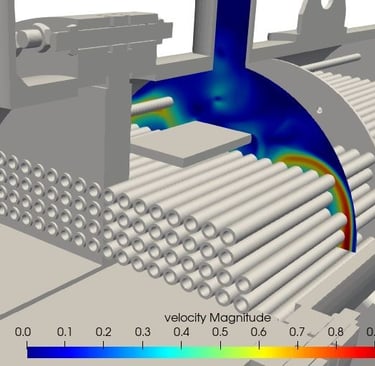
Heat exchangers are essential equipment across modern industrial operations, enabling the controlled transfer of thermal energy between two or more fluids without mixing them. These devices maintain optimal operating temperatures, recover waste heat, and ensure product quality in sectors ranging from power generation to chemical processing. By leveraging Computational Fluid Dynamics (CFD), engineers can examine the intricate fluid flow and thermal behaviors inside a heat exchanger before committing to physical manufacturing. Understanding how a heat exchanger functions, the technical methodology behind its CFD modeling, and the strategic value of simulation reveals why digital prototyping has become a cornerstone of industrial engineering.
How a Heat Exchanger Works
At its core, a heat exchanger operates on the fundamental laws of thermodynamics, specifically the principle that heat naturally flows from a warmer medium to a cooler one until thermal equilibrium is reached. In a typical setup, two fluids at different temperatures flow adjacent to each other, separated by a solid conductive barrier such as a metal tube wall or a thin corrugated plate. Thermal energy transfers from the hot fluid to the solid wall via convection, passes through the wall via conduction, and enters the cold fluid again through convection. The efficiency of this transfer depends heavily on the surface area of the barrier, the thermal conductivity of the material, and the temperature difference between the two streams.
Different industrial applications require specific geometric configurations to maximize heat transfer while managing space and pressure constraints. Common designs include shell-and-tube exchangers, where one fluid flows through a bundle of tubes while another flows over them inside a larger cylindrical shell, and plate heat exchangers, which use stacked thin plates to create narrow, turbulent flow channels. Flow arrangement also plays a critical role in performance. Counter-current flow, where fluids move in opposite directions, maintains a more uniform temperature gradient along the length of the unit and generally achieves higher thermal efficiency than parallel or cross-flow designs.
Technical Methodology of Heat Exchanger CFD Simulation
Simulating a heat exchanger using CFD requires translating physical fluid dynamics and heat transfer phenomena into mathematical equations solved over a discrete computational domain. The process begins with geometry preparation and meshing, where the three-dimensional CAD model of the fluid volumes and solid walls is divided into millions of small control volumes or cells. Because thermal and velocity gradients are steepest near solid surfaces, engineers apply fine boundary layer meshes, known as inflation layers, along the tube or plate walls to accurately capture convective heat transfer and wall shear stress.
Once the mesh is established, the simulation solves the governing Navier-Stokes equations for conservation of mass, momentum, and energy. Most industrial heat exchangers operate in the turbulent flow regime to enhance mixing and boost heat transfer rates, requiring the selection of an appropriate turbulence model. Models such as the Shear Stress Transport (SST) k-omega or Realizable k-epsilon are widely used because they balance computational cost with accuracy in predicting flow separation, recirculation zones, and near-wall thermal behavior. For conjugate heat transfer (CHT) analyses, the solver simultaneously computes fluid convection and solid conduction across the shared interfaces, ensuring a seamless energy balance throughout the entire assembly.
Material properties and boundary conditions must also be carefully defined to reflect real-world operating environments. In high-temperature applications or phase-change systems like condensers and boilers, fluid density, viscosity, and specific heat can vary significantly with temperature, requiring temperature-dependent property tables or multiphase modeling techniques such as the Volume of Fluid (VOF) or Eulerian approaches. After running the solver to convergence, engineers post-process the results to analyze velocity streamlines, temperature contours, pressure drop across inlets and outlets, and local Nusselt numbers, pinpointing areas of flow maldistribution, dead zones, or excessive fouling potential.
Improving Business Processes Through CFD Simulation
Integrating CFD simulation into the engineering workflow delivers substantial operational and financial benefits for industrial organizations. Traditionally, designing or troubleshooting a heat exchanger relied on empirical correlations and physical prototyping, which often led to over-engineered equipment with wide safety margins or costly field failures. CFD eliminates much of this guesswork by allowing teams to test dozens of design iterations virtually, optimizing baffle spacing, fin geometry, or inlet distributor designs in a fraction of the time required for physical testing. This accelerated research and development cycle brings higher-performing products to market faster while drastically reducing capital expenditure on physical prototypes.
Beyond initial design, CFD simulation directly improves ongoing plant operations and maintenance strategies. By identifying localized hot spots, erosion-prone high-velocity regions, or stagnant zones where particulate fouling is likely to accumulate, companies can proactively modify operating parameters or internal geometries before unplanned shutdowns occur. Furthermore, optimizing the balance between heat transfer efficiency and pressure drop reduces the pumping power required to move fluids through the system, leading to permanent reductions in energy consumption and lower carbon emissions. These insights empower engineering and management teams to make data-driven decisions that extend equipment lifespan, improve process safety, and increase overall profitability.
Expert CFD Consulting with tensorProc
For organizations looking to unlock these engineering and operational advantages without building an expensive in-house simulation department, partnering with an experienced specialist is a practical solution. Since 2013, tensorProc has provided dedicated CFD consulting services, helping companies solve complex fluid flow and thermal management challenges with precision. With a deep specialization in the chemical and process industries, tensorProc brings extensive domain expertise to the analysis of multiphase reactors, distillation systems, and intricate heat exchanger networks. By combining rigorous numerical modeling with practical process engineering insight, tensorProc enables clients to optimize equipment performance, resolve persistent operational bottlenecks, and drive measurable improvements across their industrial facilities.